Clinical psychology doctoral candidate paving road to SUD recovery with problem recognition research
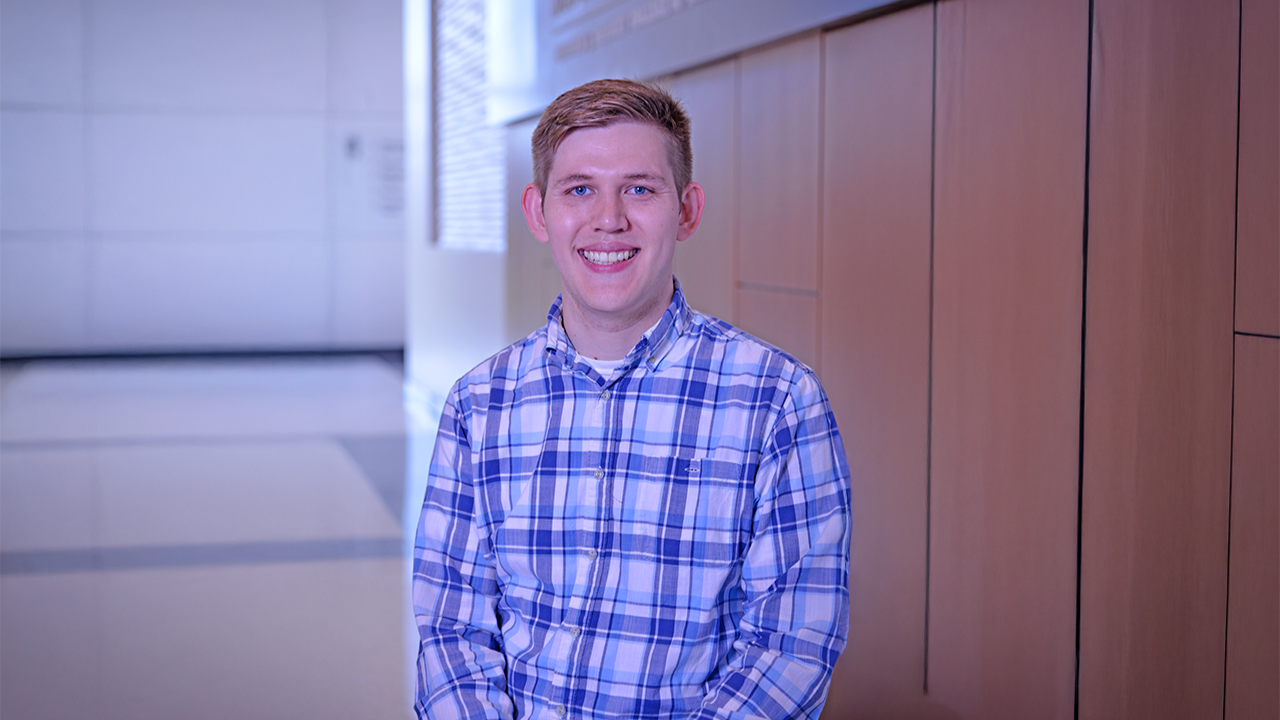
Brandon Schermitzler, a clinical psychology doctoral candidate at Auburn University, is studying the science of addiction to better help the millions of people affected by one of the country’s most widespread health crises.
As of 2021, the National Institutes of Health (NIH) reported that 16.5% of people in the United States had a substance use disorder (SUD), but less than 7% of those people received treatment. Since that publication, cannabis and hallucinogens use has reached a historic high.
“Substance use is a very prevalent issue, specifically substance use disorders,” Schermitzler said. “Through some personal experiences like family members, friends growing up, I knew that it really affected a lot of people and caused problems in a lot of different people's lives. So, I really wanted to help be the solution to some of those problems.”
Schermitzler studies how thinking and emotions, especially stress, can help change or maintain substance use problems. He uses a variety of methods, including self-report questionnaires, brain imaging and experiments that temporarily manipulate brain activity.
He said the more researchers can understand the psychological mechanisms behind substance use, the better scientists and practitioners can use those findings to develop more specific treatments.
“I hope to aid in the development of accessible interventions for people with substance use disorder,” Schermitzler said. “To develop precise interventions, it’s important to target precise psychological mechanisms. I see it as kind of a steppingstone to developing better interventions, because we have a lot of interventions that work, they just don’t work for everyone. We want things that are going to work for a lot more people.”
The NIH’s National Institute on Drug Abuse recognizes substance use disorder as “a chronic, treatable brain condition” and supports emerging scientific talent in developing treatment. In May, the NIH awarded Schermitzler the Ruth L. Kirschstein National Research Service Award Individual Predoctoral Fellowship for his current project probing brain activity around substance use.
Schermitzler’s project focuses on what happens in the brain when people with severe cannabis use disorder process information about their substance-related problems.
Participants will receive different types of brain stimulation in specific areas linked to problem recognition. Then, participants will listen and respond to personalized statements about the benefits and consequences of cannabis use while researchers monitor their brain activity.
By the end of the study, Schermitzler hopes to understand more about how emotions and thinking processes can be used in innovative substance use disorder treatments.
It’s a rigorous, technologically complex project that employs Auburn’s state-of-the-art equipment, and he said it wouldn’t be possible without support from the NIH.
“This fellowship allows me to focus solely on my research,” Schermitzler said. “It definitely is validating to be able to receive such a high honor from a federal institution. It’s incredible that they want to fund me as a scientist, and I find that very reassuring that I am on the right track and I'm in the right place and I'm making a difference.”
Prior to attending Auburn, Schermitzler earned a bachelor’s degree in psychology from the University of Minnesota and worked as a research coordinator at the University of Minnesota Medical School. He chose Auburn’s doctoral program in clinical psychology to continue his research with expert faculty.
Schermitzler said he’s grateful for the faculty and students in Auburn’s College of Liberal Arts, as well as his mentorship team that crosses institutional lines, including Florida State University’s Rick Macatee, who formerly studied cannabis use disorder at Auburn; Auburn’s Samantha Fede; and Stony Brook University’s Scott Moeller.
He said research and clinical work can be solitary, so creating teams is important for wellbeing, success and moving the field forward.
“I'm just extremely grateful and would never have had any of these opportunities if it weren't for all of their support and work that they've contributed to my career,” Schermitzler said. “Our program is extremely warm and welcoming. As long as you are persistent, you'll find some success in our program and in the field.”
Learn more about the doctorate in clinical psychology at the Department of Psychological Sciences website.
Tags: Psychological Sciences Students Research


Related Articles
-
The Conversation: Interoception and self-harm with April Smith
Associate Professor April Smith writes for The Conversation on how an increased disconnect from your body can make it easier to harm yourself. -

Philosophy professor leads webinar on aligning AI with human values
Philosophy Professor Elay Shech presented "Bias, Ethics, and AI: Aligning Algorithms with Human Values" for the EagleCast Webinar Series. -
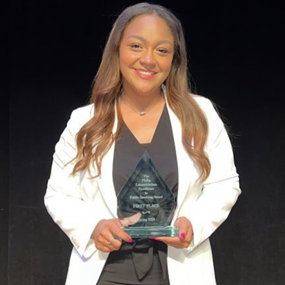
Lexi Garrett wins spring 2024 Auburn Speaks competition
Agriculture junior Lexi Garrett was announced as the winner of the competition and recipient of the Philip Lutzenkirchen Excellence in Public Speaking Award. -

AUPSC expands group therapy programs across clinics
The Auburn University Psychological Services Center (AUPSC) now offers more group therapy programs for adolescents and adults. -

College of Liberal Arts launches new research fellows program, announces inaugural fellows
The new initiative is designed to honor exceptional faculty members and strengthen the college’s commitment to research and creative scholarship. -

Doctoral student earns scholarship for work merging kinesiology, speech-language pathology
School of Kinesiology doctoral candidate Mariah Morton was awarded a New Century Scholars Doctoral Scholarship from the American Speech-Language-Hearing Foundation.