Mentoring the future: Gilbert’s interdisciplinary work inspires next-gen scholars
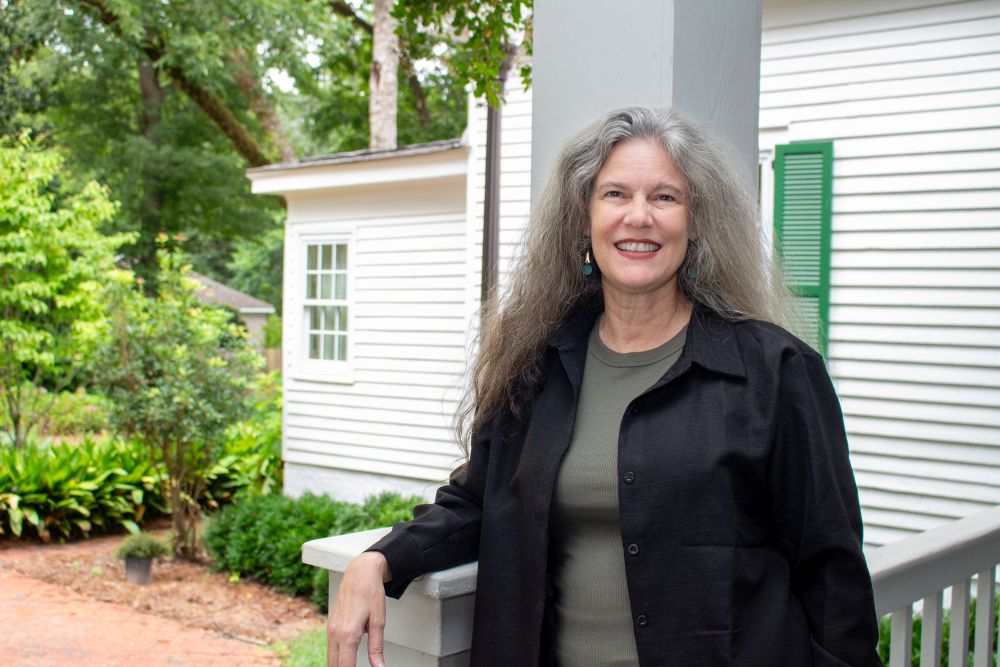
Pamela Gilbert is a globally recognized scholar, a mentor to emerging researchers and a champion of interdisciplinary thinking. As the Philpott–West Point Stevens Eminent Scholar in the Department of English, she brings fresh insight and academic depth to Auburn University’s College of Liberal Arts, enriching classroom dialogue and helping students navigate today’s evolving academic landscape.
Gilbert’s academic journey began earlier than most. A first-generation college student living in a foster home, she enrolled at just 15 years old and quickly found herself drawn toward the humanities.
“I started as a biology major with an English minor. After the first semester or so, I realized that I could be maybe a mediocre biologist, but I was spending all of my time and energy on my minor. So I switched majors, and then I missed the science enough that I did a second major in psychology with an emphasis on physiological psychology,” she said.
That blend of science and literature has shaped her work ever since.
Gilbert’s research investigates how novels, medical texts and cultural narratives influence how we understand identity, illness, emotion and the body. She has authored five influential books and her work also includes many edited collections—including “Victorian Skin: Surface, Self, History” and “Cholera and Nation”—and she leads major publishing initiatives with Cambridge and SUNY Press.
Her contributions to the field have earned international recognition, including a Guggenheim Fellowship and prestigious research fellowships at Oxford, Cornell and the University of Edinburgh. Currently, she’s editing a landmark collection on literature and science in the 19th century, a time when disciplines like biology, sociology and anthropology were beginning to emerge.
At Auburn, she’s channeling her expertise into supporting the next generation of scholars.
“At this moment in my career, I’m really focused on mentoring and service to the profession." ~ Pamela Gilbert
Philpott–West Point Stevens Eminent Scholar
“When you're working with graduate students and junior scholars, you are mentoring people in the basics of research but also in finding a topic and thinking about career choices," she said. "Life happens, and that can be very disorienting if you have a sort of straight line vision of what you think your life is going to be.”
In scholarship and teaching, Gilbert is a vocal advocate for the power of a liberal arts education.
“Most careers will train you on the job for what the job is,” she said. “What employers are really looking for are well-rounded people who have a lot of cultural knowledge, who have curiosity about other people, who can put things in a context. Humanities disciplines are a great choice of a major for undergraduates across the board. Obviously, depending on your career goals, you might want to think about different minors or second majors.”
She also brings a thoughtful voice to one of the most pressing issues in higher education today: the rise of artificial intelligence in student learning and writing.
“I'm not an AI expert, and my own understanding of AI is evolving,” she said. “AI has its good uses. But in the humanities, writing is thinking. If I'm asking AI to summarize something for me and give me some talking points, I'm not going through that process in the same way.”
“When you source quotes for a paper, the implication is that you've read the document, you chose those quotes for a reason and you've constructed an argument that uses the quotes to support your argument. None of that is happening when you ask AI for some quotes that do or don't exist. It’s not going to mean that you've actually learned anything or produced anything original.”
Through her research, leadership and deep commitment to student development, Gilbert is adding fresh energy and perspective to the College of Liberal Arts. Her work supports Auburn’s mission to cultivate critical thinkers and lifelong learners, preparing students for lives of impact and purpose.
Learn more about Gilbert’s background and research.
Related Articles
-
Island Press publishes Retzlaff's 'Justice and the Interstates: The Racist Truth about Urban Highways'
"Justice and the Interstates" examines the toll that the construction of the U.S. Interstate Highway System has taken on vulnerable communities over the past seven decades. -

AI Nexus conference exploring intersection of human, artificial intelligence
The College of Liberal Arts Office of Strategic Initiatives and Programs will host “The AI Nexus: The Arts, Humanities and Engineering Converge,” a one-day conference that unearths connections between AI, art and the humanities on Thursday, Feb. 12. -

Music professor appointed editor-in-chief of the Journal of Singing
The National Association of Teachers of Singing (NATS) has named Matthew Hoch, professor of voice, as the next editor-in-chief of the Journal of Singing, the premier peer-reviewed publication in the field of voice pedagogy. -

Auburn faculty lead restoration of historic Alabama school
The exterior of a 102-year-old school is back to its former glory after a restoration project by interdisciplinary faculty members from the College of Architecture, Design and Construction and the College of Liberal Arts. -

Templeton Ideas: Plato Warned Us About ChatGPT (And Told Us What to Do About It)
Professor of Philosophy Elay Shech discusses how, long before the printing press or ChatGPT, Plato was already worried about what new technologies might do to us. -

AI@AU ethics committee members part of National Science Foundation research grant to integrate AI ethics into STEM education
The initiative, "Leveraging the Ethics Bowl Framework for Artificial Intelligence Ethics Education," aims to transform AI ethics education by integrating the ethics bowl model into STEM curricula.