Professor Melissa Blair answers: Was the Revolution revolutionary for women?
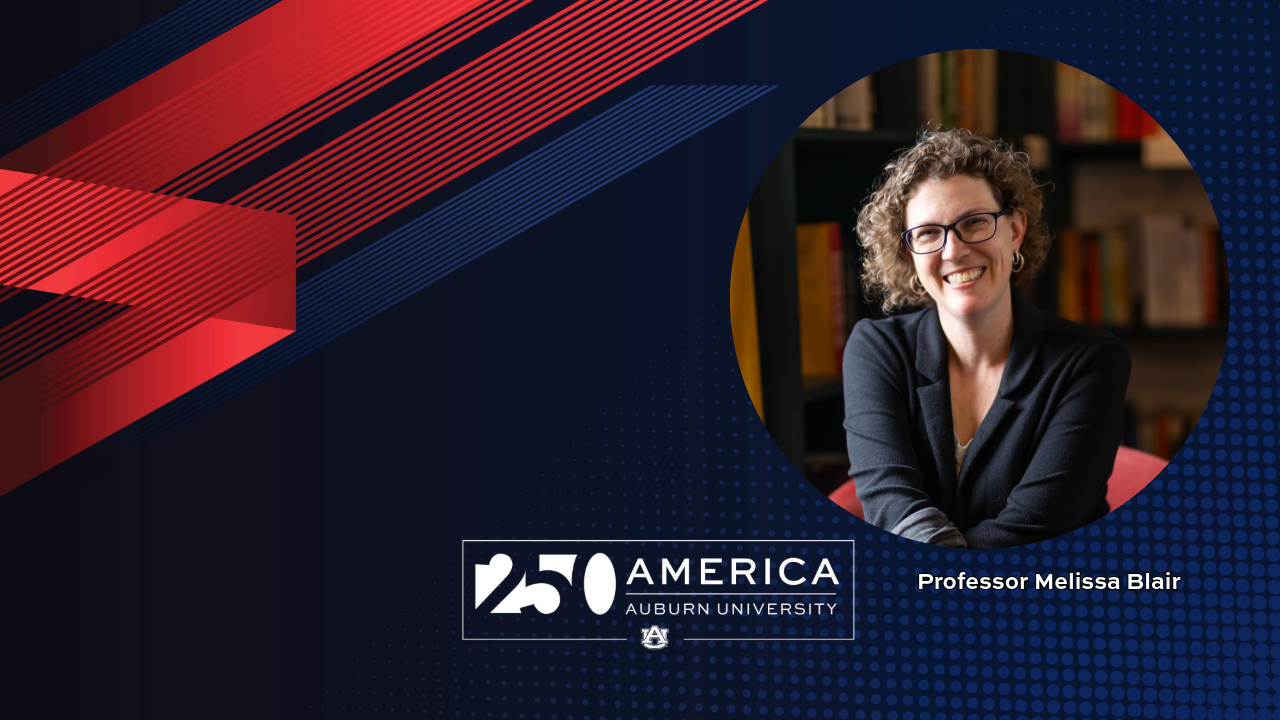
As the United States approaches its 250th anniversary, Auburn University’s College of Liberal Arts is encouraging the community to revisit the American Revolution through the lives and legacies of those often left out of traditional textbook narratives.
On Jan. 28, Auburn’s Department of History, the Caroline Marshall Draughon Center for the Arts & Humanities and the Osher Lifelong Learning Institute at Auburn hosted Professor Melissa Blair for a timely and thought-provoking lecture that asked a question still relevant today: Was the American Revolution revolutionary for women?
The event was part of US 250: Perspectives from Auburn University History Faculty, a seven-week course designed to bring fresh academic insight to the ways the Revolution continues to shape American life, from political identity to civic participation.
Blair, professor and chair of Auburn’s Department of History, delivered a presentation that emphasized how women were not passive bystanders to the Revolution, but active participants who shaped its outcomes — often without formal legal rights, recognition or access to power.
She began by exploring how seemingly ordinary domestic roles, like making clothes or choosing what to drink, became political acts in the years leading up to the war.
“Women's participation in boycotts was absolutely essential because they were the ones who were drinking the tea. They were the ones who were making the clothing. They had to get on board with this, or these boycotts would not succeed.” ~ Professor Melissa Blair
She explained how women were celebrated in newspapers such as “Daughters of Liberty” and highlighted the Edenton Tea Party, where 51 women in North Carolina signed an official petition indicating their support of the Revolution.
“That's one of the first recorded instances we have of what we would call more formal political participation by women in the colonies. It will not be the last,” she said.
As the war escalated, women’s lives were upended. Many stepped into leadership roles, managing farms and businesses in the absence of men, housing soldiers, navigating scarcity and surviving violence. Some even disguised themselves as men to fight on the front lines. Others followed the Continental Army, serving as unpaid laborers, cooks and caregivers.
One of the most compelling stories Blair shared was that of Esther de Berdt Reed, who led a major fundraising campaign in Philadelphia in 1780. Reed and her network raised more than $300,000 for the Continental Army. Blair described a spirited back-and-forth between Reed and George Washington. Reed wanted the money given directly to soldiers as bonuses, while Washington preferred it be used for supplies like shirts.
Reed ultimately relented, but the moment marked a shift in how women were beginning to assert political agency.
Blair expanded the conversation to include women on the margins of the Revolution, including those who were enslaved, Indigenous or Loyalist. She highlighted Elizabeth Freeman, an enslaved woman whose legal case helped pave the way for the abolition of slavery in Massachusetts.
But she also noted that progress was far from equal.
“The Revolution doesn't change a whole lot for enslaved people in the South, or really for enslaved people in the Mid-Atlantic either, because of gradual emancipation laws.”
Native American women, many of whom had allied with the British in hopes of protecting tribal sovereignty, were ultimately betrayed as their treaty rights were ignored by the new U.S. government.
After the war, the legal doctrine of coverture remained firmly in place. Married women still had no legal identity apart from their husbands and were unable to vote, own property independently or participate in formal politics.
However, Blair pointed to the emergence of Republican Motherhood, a cultural shift that reimagined women’s roles within the home. Within this framework, women were entrusted with raising informed, virtuous citizens. It planted the seeds of future civic influence and laid early groundwork for organized movements that followed, including suffrage, education reform and the fight for gender equality.
Over generations, women drew on the revolutionary spirit to demand a more inclusive version of freedom that extended beyond rhetoric into tangible rights, representation and reform.
Blair’s lecture left listeners with a powerful takeaway: while the American Revolution did not deliver total political equality for women, it sparked questions that still shape American democracy today.
Tags: Faculty History Center for the Arts and Humanities


Related Articles
-

Always Auburn, always faithful: Donors support Marine Corps students
Bob and Cara Barber have strong roots in Auburn and the U.S. Marine Corps and are now committed to ensuring more Marine students have the scholarship support they need to thrive on the Plains. -

AI@AU ethics committee members part of National Science Foundation research grant to integrate AI ethics into STEM education
The initiative, "Leveraging the Ethics Bowl Framework for Artificial Intelligence Ethics Education," aims to transform AI ethics education by integrating the ethics bowl model into STEM curricula. -

Kennington receives NEH Fellowship for book on mental illness, gender in American South
Kennington's project, "Womanhood, Insanity, and Consent in the Nineteenth-Century South," will investigate mental illness, gender and law in the American South. -

Award-winning author Kiese Laymon visiting Auburn University
Join author Kiese Laymon at Auburn University as he hosts an open Q&A, presents a reading of his own award-winning work and speaks with Associate Professor of English Ernest Gibson III. -
Psychological sciences professor developing intervention to reduce stress, harm for individuals with cannabis use disorder
Macatee's latest project will test an intervention model that delivers just-in-time text messages with therapy content to reduce negative feelings and harm in individuals with cannabis use disorder. -

WTVM: Government shutdown reaches day 3 as federal workers face uncertainty
Political Science Professor Joseph Aistrup discusses the ongoing government shutdown for WTVM.