Lighting, costumes flesh out Fleet Street for Auburn’s ‘Sweeney Todd’ production
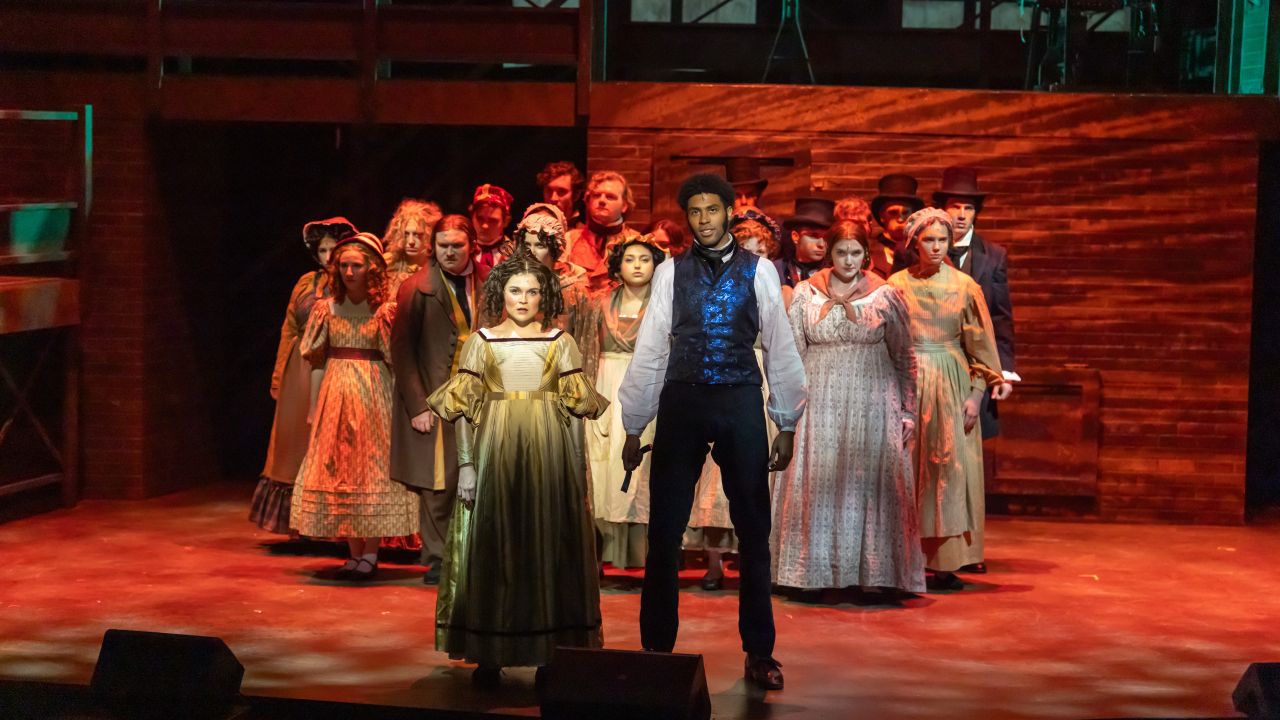
The Department of Theatre & Dance cordially invites you to visit Fleet Street, London, circa 1820, where a barber is seeking sweet revenge and a pie shop owner is keeping a deliciously sinister secret.
You won’t need a time machine to visit – only a ticket for “Sweeney Todd: The Demon Barber of Fleet Street.” Lighting Designer Danielle Curtis and Costume Designer Jennifer Salter, both new faculty at Auburn, will make the rest of the experience real.
“The goal is to make certain that we're telling a compelling story that people enjoy and want to come see again, but we also don't want to be noticed at the same time,” Curtis said. “We really are there to make the actors become the people in the story and showcase the story. The written word that they give us – that’s the most important part of the whole production.”
When Curtis sees an empty stage, she envisions everything it could be through the lens of color and texture. She can time travel, change the weather and teleport audiences to fictional places by manipulating angles of light and color.
Curtis said when she is successful, the viewer won’t so much see her work as feel it.
My favorite part is finding the emotional connections that you can create. Find your audience, the experiences they’ve had and the ways you can speak to them. It is becoming easier for lighting to manipulate people’s minds and influence their emotions. ~ Danielle Curtis
Lighting Designer
Another invisible labor of the lighting designer is the hours of research to create the right atmosphere on stage.
“Sweeney Todd” is a darkly comedic musical thriller set in 19th-century London. Curtis’ research on its setting within the Industrial Revolution informed choices such as the hazy light seeping through the stage decorations and the greenish-blue pollution melting into vibrant red-orange sunsets.
A window unit at the back of the stage, which is also a projection surface, shows the interplay of colors and creates dramatic cues with images such as blood spatter across glass.
At the same time, Salter is telling a story with color and texture on fabric. The way clothes represent history has always been a passion for her, and improvements in lighting technology allow her to include more details in her costume designs.
One of her research specialties is textile history. For “Sweeney Todd,” she balanced historical accuracy with creative expression to bring the story to life.
“In Sweeney Todd, the story is the hero. It’s a period piece, but it’s not a play about costumes. It’s really easy for period pieces to become about costumes if you’re not careful,” Salter said. “So, for this show in particular, I wanted it to feel lived in and real and have a lot of layers and textures and saturation because we have a lot of that surrounding us at all times. That lets the audience get themselves absorbed into the story, and what people are wearing is telling that story subconsciously.”
Characters will be dressed in costumes inspired by the early Victorian era, which was when the play was originally published as a penny dreadful. The costumes feature soft silhouettes which contrast against the harsh background and muddy, sickly colors that reflect the grimy atmosphere of Fleet Street.
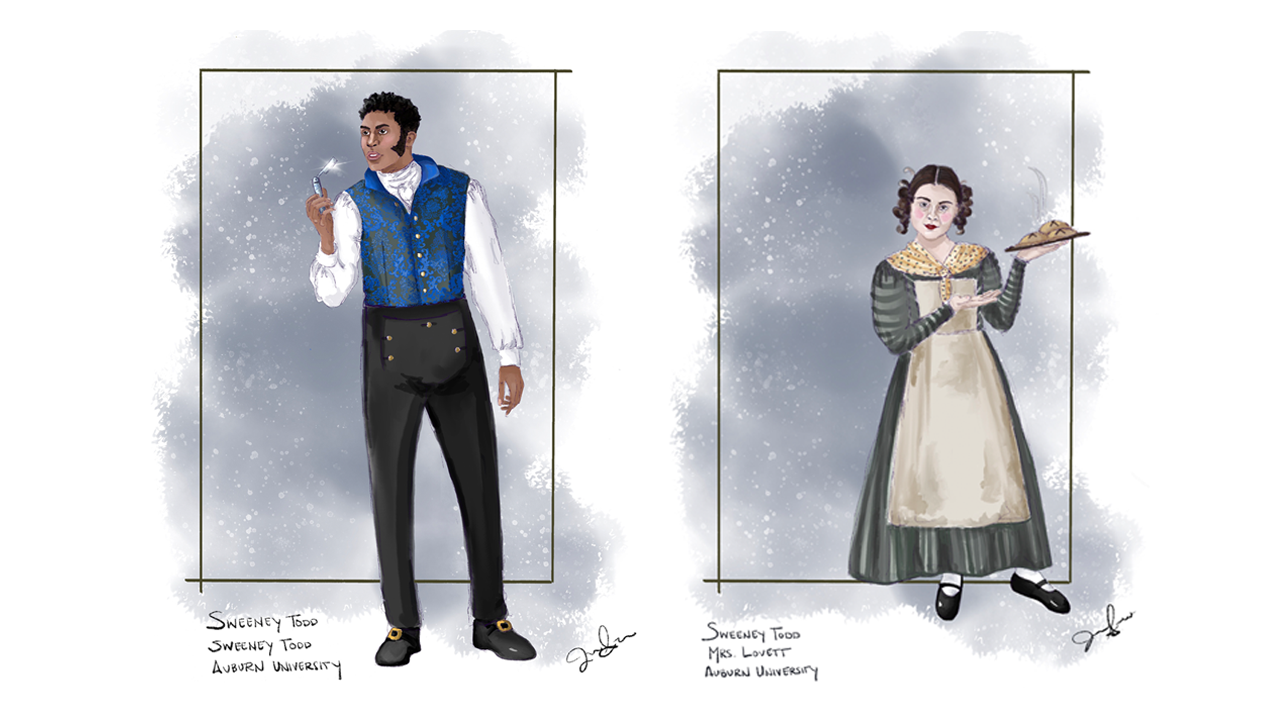
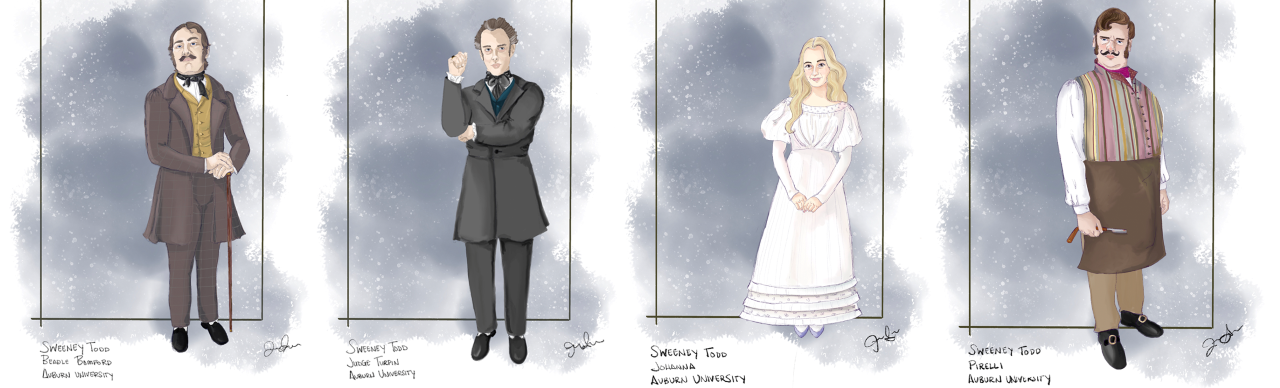
Costumes also tell the story of a character’s personality, past and status. For example, the beggar woman wears an outdated Regency gown, as new clothes were expensive and lower class people relied on mending what they had. A character who comes into money dresses expensively, but without taste, and wealthy characters wear cleaner-looking clothes.
Salter collaborates with Curtis on how costumes appear under the lights, and they both must consider the actors. Salter may change a dress design so an actress doesn’t trip on stairs, and Curtis may adjust haze so that actors don’t have trouble breathing.
Between them, the director, faculty, staff and dozens of talented students, the production works to entrance audiences from the opening number.
“My goal from the beginning is always to help tell the story and to start from a place of collaboration,” Salter said. “We are really lucky to have amazing collaborators and professionals who are willing to take on our crazy ideas and bring them to life, and do so in a timely and very skilled manner.”
Beyond creating experiences onstage, a shared goal of Curtis and Salter is to get more students interested in the BFA in Design and Technology program.
Curtis, who’s worked in both academia and off-Broadway in New York City, said she joined Auburn to be both artist and teacher within a department with unchecked creative freedom that supports its students.
“The students just go after anything. They feel very supported, so they're not afraid of failing,” Curtis said. “In our areas, we are trying to make certain that our design students get those opportunities but feel like they have somebody to fall back on if they need to, and we're always here to help.”


The Design and Technology program offers a practical foundation in all areas of theatre production, including scenic, lighting, sound, costume and property design, technical direction and construction. It prepares students for careers in theatre, film, television, concerts and other entertainment.
Salter said it’s an excellent career path with a high employment rate for students interested in creating magic on stage.
“Theatre tech is the unsung hero of theatre,” Salter said. “Our students are working behind the scenes, creating beautiful work, and getting professional experience before they graduate. If there are students across campus who want to get involved, design tech is a great way to get involved in theater. You don’t have to be on stage to be part of telling stories.”
“Sweeney Todd: The Demon Barber of Fleet Street” will run from Feb. 19-28 at the Telfair B. Peet Mainstage Theatre.
Learn more about the show and buy tickets at the box office website.
Tags: Theatre and Dance Arts and Culture Research Faculty


Related Articles
-

Auburn speaker series continues dialogue about importance of humanities in health care
The Medical and Health Humanities Speaker Series brings together faculty, staff, students and community members to introduce the importance of the humanities in health care. -

Come hear another tale of grit and grace with Auburn University Theatre and Dance’s production of "Spring Awakening"
In a world where adults set the rules, silence dissent and control the story, a group of young people struggle to articulate their feelings and chart their own course. -

Professor Melissa Blair answers: Was the Revolution revolutionary for women?
Blair, professor and chair of Auburn’s Department of History, delivered a presentation that emphasized how women were not passive bystanders to the Revolution. -

Eric Marcus’ early passion for philosophy fuels an influential career
Marcus was named a recipient of the university’s Creative Research and Scholarship Award. -

Preparing professionals: PR Professor Brigitta Brunner recognized for excellence in real-world teaching
Public Relations Professor Brigitta Brunner has earned numerous recognitions for her teaching, but she says the real award is the professional success of her students. -

The Conversation: How the CIA director helps the US navigate a world of spies, threats and geopolitical turbulence
Senior Lecturer of Political Science Matthew Clary discusses the CIA director's role in national security and how the position has changed over time.